
BIOGRAPHY
James Holvay’s fruitful, fascinating history in music has played out in two acts, divided by an intermission.

His career took root amid the bustling, hustling record business scene of the ‘50s and ‘60s in his hometown of Chicago, rose with a hand in the creation of the Toddling Town’s “horn rock” sound, and climaxed with writing a song that reached the pinnacle of the American singles charts. Then, after a long break, he returned in his ‘70s with new songs and a series of new recordings that brought his hometown’s soul sound back to life.
Growing up in the suburb of Brookfield west of Chicago’s downtown Loop, James caught the rock ’n’ roll bug when his older brother brought home Bill Haley & the Comets’ “Rock Around the Clock,” the 45 that kickstarted many a young musician’s interest. He began playing guitar at 12, and started writing songs soon thereafter, inspired by a local R&B star.
“Curtis Mayfield was the guy that I always idolized,” says James. “I always gravitated toward black music when I was a kid. My roots were always in black music.”
Barely in his teens and encouraged by his father, James joined the hordes of cleffers peddling their numbers door-to-door at “Record Row” on Chicago’s South Michigan Avenue, the home of the city’s many independent record labels, music publishers, and retail distributors. Such storied imprints as Chess and Vee-Jay observed something like an open-door policy in a competitive hunt for hits. One stop earned him an audience with Calvin Carter, brother of Vivian Carter, one of Vee-Jay’s partners, and the label’s top A&R man and producer.
James recalls, “Behind his desk was this this big plaque from BMI, and it said, ‘To Calvin Carter for ‘He Will Break Your Heart’ – One Million Seller.’ And the writing credit said, ‘Mayfield-Carter-Butler.’ I said, ‘Wow, you wrote that?’ He said, ‘Yeah, me and Curtis and Jerry.’ I said, ‘Oh, I love Curtis Mayfield.’ And he said, ‘You want to meet him?’ And he was at the office! He comes in, a little guy, real humble. You could barely hear him when he talked. I said, ‘Oh, you’re the greatest!’ I was probably 15. That was all embedded in my brain.”

The young aspiring songwriter soon fell in with Joe DeFrancesco, a local music promoter and manager. “He would drive around and find these doo-wop guys on the corner,” James remembers. “I’d go write a song and we’d record it, and then we’d go down to Michigan Avenue and try to sell it to somebody, to get a couple hundred bucks back for the session.”
James, who had formed his first group, the Rockin’ Rebels, in seventh grade, moved on to expand his reach in the business with work in a host of local bands catering to the musical appetites of local teens. Jimmy & the Jesters, the MayBees, the Chicagoans (aka the Livers), and the Executives (the house band for Dick Clark’s touring Caravan of Stars, which included bassist James William Guercio, later the manager and producer of the band Chicago) all made their mark with local and national appearances at dance parties, sock hops, and concerts, live TV shots on Chicago’s WGN, and several independently released singles.

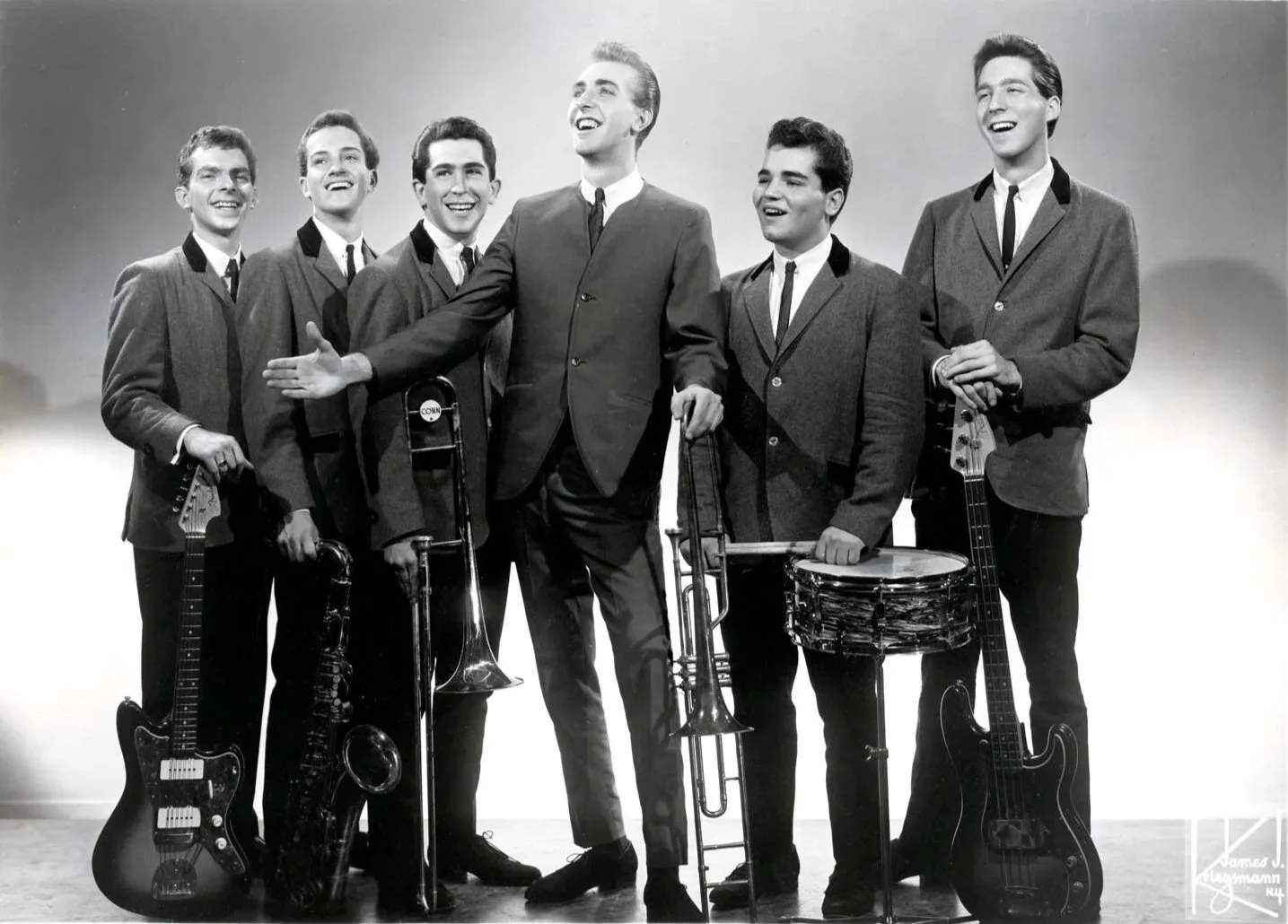
This work culminated in the formation in 1966 of the MOB, a horn-inflected unit that flashed an image reflecting the Windy City’s gangland history of the ‘20s and ‘30s, and featured James and his longtime playing and writing partner Gary Beisbier.
“When I put the MOB together, it was basically a white soul band, a blue-eyed soul band,” James says. “We had the horns, and the guys were jumping all over the stage in pinstriped suits, and we were thinking we were going to be the Beatles.”
The MOB’s brass-based sound would definitely have an impact on the direction that Guercio’s act Chicago took a couple of years later, at the beginning of their multi-platinum career. But it was James’ songwriting talents that took him to the top of the American charts. After authoring tunes for such popular artists as Brian Hyland (whom he supported as a guitarist on the Caravan of Stars tour) and Dee Clark, he passed one of his compositions, “Kind of a Drag,” to Carl Bonafede, manager of a Chicago group called the Buckinghams.


“I didn’t hear anything for a year,” Holvay remembers. “One of the guys in the band came into the club and said, ‘You know that song you were playing to Carl a long time ago? I think I heard it on the radio.’ I said, ‘What?’ After I gave Carl the song, the Buckinghams played it in their set at their record hops at the Holiday Ballroom, and the kids would come up and tell them, ‘Oh, I like that song.’”
Signed to U.S.A. Records – an imprint based on Record Row and operated by local record wholesaler All State Distributing – the Buckinghams scored an immense hit in Chicago with “Kind of a Drag,” which soared to No. 1 on the “Silver Dollar Survey” of WLS, the city’s 50,000-watt AM rock ‘n’ roll giant. It ultimately reached the apex of the American singles chart in late 1966 after it was picked up by Columbia Records, then the reigning U.S. major label. The group released three more national hits co-authored by James and Gary Beisbier in 1967: “Don’t You Care” (No. 6), “Hey Baby (They’re Playing Our Song)” (No. 12), and “Susan” (No. 11).
Riding high with these nationwide smashes under his belt, James devoted his energy to the MOB. The band toured regularly and issued several singles and LPs on Colossus, Private Stock, and other indie labels. But, after 15 years on the road, the act disbanded after a New Year’s Eve 1980-81 date in Los Angeles.

Settling in Southern California, James segued to a decades-long career in sales for a prominent office equipment company. But music remained an itch, and after the turn of the millennium the momentum of a new musical movement led him to scratch it. “What got me started again was I began to hear Sharon Jones and the Dap-Kings and Amy Winehouse,” he says. “All of a sudden I’m hearing this indie soul thing from the ‘60s coming out again. There were a whole load of these bands out there, all over the world, in Spain, Italy, England. And I said, ‘God, that’s my music!’ So that music inspired me, and the songs I was writing were in the Major Lance-Gene Chandler-Curtis Mayfield vein. That’s who I am, in my heart.
“I started making cassette tapes in my bedroom. Then I met Steve Cohen, who’s from Chicago. I went over to his little studio in North Hollywood. He said, ‘Oh, there’s a Curtis Mayfield vibe.’ And I thought, ah, he knows what I’m doing. So I started recording songs two or three years ago. Then I started to polish them over a year ago. I met our mixing engineer Cameron Lew and I played him some stuff. He’s a Motown fan, and he went, ‘Oh, man, I know exactly where you’re at.’”
The musicians James needed to realize this renewed musical vision were drawn from L.A.’s large pool of well-traveled pros. “I started to go to clubs around town and get referrals on people who I saw who I thought could play the music,” he says. “I finally found some great players – these are the guys who go out with the O’Jays and the Temptations and Earth, Wind & Fire. They’re road guys, road warriors. The keyboard player had worked at Motown. That’s why the quality of the recordings and the grooves are so good.”
In 2021, James released his debut solo EP, Sweet Soul Song, on his own imprint, Mob Town Records. His original compositions mirroring Chicago soul roots, his sweet Mayfield-inspired vocalizing, and the authentic horn-driven old-school R&B sound of the record drew praise from a plethora of specialist publications and web sites and a 3,000- word feature profile by historian-DJ-artist Steve Krakow in his hometown alternative weekly the Chicago Reader.

Employing the same production team, James swiftly returned with a second EP, 2022’s This Girl, which mixed three new compositions and remakes of two Holvay-Beisbier oldies but goodies originally recorded by the MOB.
James says, “I thought, why don’t I mine some of the better MOB songs that I personally like, and redo them the way I wanted them done in the studio? I wanted to pick out the best stuff that I had and put it on the second EP. Although Jerry Ross of Colossus Records did an excellent job recording ‘More of You,’ it was different than the way we used to do it. The song is very Chicago soul, very Jerry Butler, in that whole bag. The same goes for ‘She’s Gone Away’. I recut that because that was one of our best ballads. I used to sing that song in the show.”
In early 2025, James’ vital brand of old school R&B was brought across the pond to U.K. listeners with the release of the Windy City Soul Production EP Working Man by LRK Records, an independent Cambridgeshire imprint with an audience of British Northern Soul enthusiasts. That five-track release was succeeded later in the year by an LRK 45 that paired the title tracks of the earlier EPs, “Sweet Soul Song” and “This Girl.”
LRK’s Liam Kenney said, “James Holvay is one of the real foundations of the Chicago soul sound. He’s got that Curtis influence, that blue-eyed soul feel, and a style that’s completely his own. He’s been part of this music for decades, and you can hear all of that history in what he’s doing now. He’s a real favorite here at LRK — his last single was one of our big sellers, which just shows how much people still connect with what he does.”
Aaron Cohen, author of Move On Up: Chicago Soul Music and Black Cultural Power (University of Chicago Press, 2019), said of the single, “It is a sheer joy to hear James Holvay expertly deliver his 21st century version of classic 1960s Chicago soul. With a flowing voice that echoes his hometown heroes—think Curtis Mayfield and Gene Chandler—he shows why this sound remains so singular: the sharpest arrangements frame the kind of beats that gets everybody to step together.”
The novelist F. Scott Fitzgerald once said, “There are no second acts in American lives.” He obviously never got a chance to meet James Holvay, the guy known in Chicago as “Jimmy Soul” who has taken the city’s classic and undying sound into the 21st century for a remarkable second act of his own.
—Chris Morris, December 2025